
Thin Film vs. Thick Film Resistors: An Engineer’s Complete Guide to Choosing the Right Technology
Overview
Selecting the right resistor has a direct impact on the performance and reliability of electronic designs. Among the various technologies available, thin film and thick film resistors are among the most commonly used—each offering distinct advantages.
This article outlines their key differences and helps you choose the most suitable option for your application.
In summary:
- Choose thin film resistors for high precision applications.
- Choose thick film resistors for cost-sensitive or more demanding environmental conditions.
Thin Film Resistors: Fundamentals, Characteristics, and Applications
Key Characteristics of Thin Film Resistors
- High precision resistors: tight tolerance ranges from ±0.1% to ±1%
- Low Temperature Coefficient (TCR): typically ±5 to ±25 ppm/°C, ensuring stable resistance over temperature variations
- Low noise performance: uniform metal film structure reduces electrical noise
- Excellent long-term stability: minimal resistance drift, enabling longer calibration cycles
- Miniaturization capability: precise control of film thickness and geometry supports compact, high-density PCB design
Typical Applications
Thin film resistors are widely used in applications where accuracy, stability, and low noise are critical, such as:
- Test and measurement equipment
- Industrial and precision control systems
- Medical electronics
- Automotive sensing and control circuits
Their combination of high precision and long-term reliability makes thin film resistors the preferred choice for demanding electronic design
Thick Film Resistors: Fundamentals, Characteristics, and Applications
Thick film resistors are manufactured by screen printing a resistive paste onto a ceramic substrate, followed by high-temperature firing to create a durable conductive layer. This production method enables high-volume manufacturing, cost efficiency, and a wide range of available resistor values.
Key Characteristics
- Cost-effective and ideal for mass production: well suited for high-volume applications
- High environmental robustness: resistant to humidity and mechanical stress, making them ideal for industrial environments
For sulfur-rich environments, anti-sulfur resistors are recommended to ensure long-term reliability
- Higher voltage capability: supports higher working voltages within the same package size
- Wider tolerance range: typically ±1% to ±5%
- Strong pulse endurance: performs reliably under surge and inrush current conditions
Typical Applications
Thick film resistors are widely used in applications where durability and cost efficiency are more important than ultra-high precision.
- Home appliances
- Industrial equipment
- Power-related systems
Key Differences Between Thin Film and Thick Film
Understanding these differences helps ensure optimal component selection.
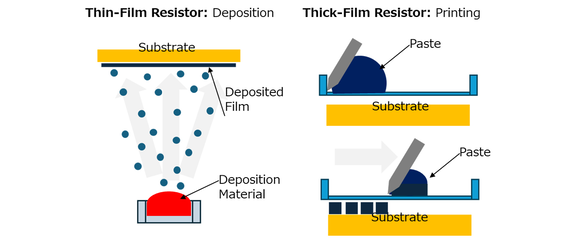
Manufacturing Process
- Thin film:
Metal deposition → micro patterning → nanometer level thickness control - Thick film:
Printed resistive paste + firing → lower cost and high volume → micrometer level thickness control
Figure 1. Overview of the Manufacturing Processes
Relationship Between Film Thickness and Resistance
Resistance depends on resistivity (ρ), length (L), width (W), and film thickness (t)
Thin film allows precise control of t, enabling tight tolerance via laser trimming.
Thick film printing introduces variation due to paste distribution, shrinkage, and microstructure, resulting in wider tolerances and higher TCR.
Uniformity, Trimming, and Material Factors
- Thin film: higher uniformity, denser crystalline structure, low noise, better TCR; Laser trimming provides fine and highly accurate adjustments.
- Thick film: microstructure with glassy phases increases TCR; trimming can induce stress or microcracks.
This is why thin film resistors are typically associated with higher precision and better temperature stability.
Performance Comparison
| Characteristic | Thin Film Resistor |
Thick Film Resistor |
| Tolerance | (±0.1% to ±1%) | (±1% to ±5%) |
| TCR | (±5 to ±25 ppm/°C) | (±100 to ±300 ppm/°C) |
| Noise | (Low) | (Adequate for general use) |
| Enviromental Resistance | Good | Excellent |
| Withstand Voltage | Good | Higher in same size |
| コスト | Higher | Lower |
Please check for more information as well our datasheets.
4. Application-Based Selection Guide
When to Use Thin Film Resistors ?
- Precision measurement equipment
- Precision analog circuits
- Circuits requiring minimal temperature drift
When to Use Thick Film Resistors ?
- Consumer electronics
- Industrial equipment
- Applications needing higher withstand voltage, surge durability, or better environmental resistance
Summary: Key Selection Points
- Precision & temperature stability → Thin film
- Cost & environmental robustness → Thick film
- High voltage capability → Thick film
Understanding these trade offs enables optimized circuit design
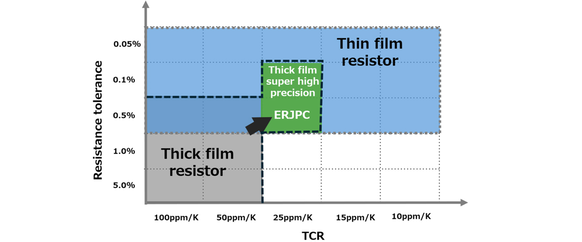
Thin film resistors are the preferred choice for applications that demand high precision and long-term stability, while thick film resistors are well suited for cost-sensitive designs requiring strong environmental robustness. Understanding the differences between these technologies helps you select the best option to optimize performance and reliability.
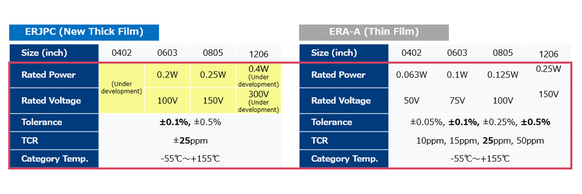
Panasonic’s ERJPC series combines the advantages of both worlds, delivering thin film–level precision within a thick film design, making it an excellent choice for demanding applications.
Frequently Asked Questions
Question: What is the most significant difference between thin film and thick film?
Answer: The main differences arise from their manufacturing processes, leading to trade-offs in precision, TCR, noise performance, cost, and environmental robustness.
Thin film resistors excel in high precision and low noise, while thick film resistors are advantageous in terms of cost efficiency, environmental durability, and higher withstand voltage.
Question: How do they differ in noise performance?
Answer: Thin film exhibits lower noise, beneficial for low-level analog signals. For digital or general divider applications, thick film is often sufficient.
Question: Which has a higher withstand voltage?
Answer: Thick film typically withstands higher voltages for the same package size.
Question:Which one offers better long-term stability?
Answer: Thin film generally shows smaller drift. Thick film can achieve long-term reliability with proper grade selection.
Question: How do they compare in cost?
Answer: Typically Thin film > Thick film, although thin film may reduce system-level cost through fewer compensations or calibration requirements.
Question: Can thick film resistors replace thin film ones?
Answer: Yes—if tolerance, TCR, noise, and voltage/pulse requirements are satisfied.
Please see as well our high precision thick film resistor series ERJPC achieves thin film class accuracy while maintaining the advantages of thick film technology.
Question: Which is stronger against pulse loads?
Answer: Thick film resistors are generally more robust. Their printed structure provides better energy dispersion and heat dissipation, making them more tolerant of inrush currents and surge events. Thin film resistors, on the other hand, may be more susceptible to localized heating due to the trimming grooves in their precision film structure.
Be sure to follow the surge standards (e.g., evaluations based on IEC 61000 4 5) and the pulse load ratings specified in the datasheet. Also note that allowable energy differs between short pulses (µs range) and long pulses (ms and above).
Question: How about sulfur resistance?
Answer: Electrode systems that contain silver (Ag) can react with sulfur (S) to form silver sulfide, which may cause resistance drift or even open circuit failures. In environments with high sulfur exposure—such as industrial sites, areas near tires, rubber molding processes, hot springs, volcanic gas regions, or food processing facilities that generate sulfur compounds—thick film anti sulfur types (Ag free electrodes, reinforced barrier layers, or special protective coatings) should be used.
Thin film resistors, which typically use Ni based alloy electrodes, are generally more resistant to sulfurization, but evaluation is still essential in extreme sulfur environments. We recommend reviewing each manufacturer’s sulfur resistance test data (e.g., ASTM B809 or their proprietary JIS based tests).
We offer a lineup of high durability, high reliability thin film chip resistors engineered with a specialized structure that provides excellent resistance to sulfurization.
Downloads
| Name | Size | Date | Language |
|---|---|---|---|
| High Precision Thick Film (Super high precision type): ERJPC Series | 444 KB | 27.01.2026 | English |
| Name | Size | Date | Language |
|---|---|---|---|
| ERJPC Super High Precision Thick Film Resistor | 669 KB | 13.04.2026 | English |