
How Panasonic Components are Shaping the Future of Robotic Arms
Introduction and background of Factory Automation
The global manufacturing sector is undergoing a major transformation. In many developed nations, declining birth rates and aging populations have led to severe labor shortages, creating pressing challenges for production. As a result, factory automation has emerged as a critical solution.
Industrial robots are at the forefront of this shift, delivering key benefits such as:
-
Continuous 24/7 operation
-
Elimination of hazardous or repetitive tasks
-
High precision in processes
-
Enhanced overall productivity
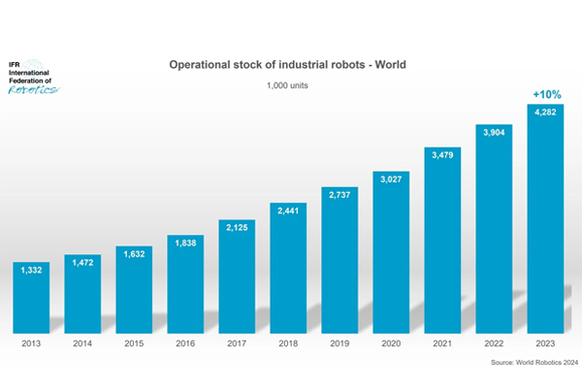
Data from the International Federation of Robotics (IFR) highlights this trend: in 2023, approximately 540,000 industrial robots were installed worldwide. Today, factories across the globe operate a record 4,281,585 units, representing a 10% increase compared to the previous year.
This article explores the key technical hurdles in the fast-paced evolution of robotic systems and highlights Panasonic’s passive component solutions that make these advancements possible. It emphasizes targeted approaches to major challenges, including ensuring durability in extreme conditions and achieving compact designs.
Overcoming technical challenges in Robotics: How Panasonic components drive innovation
Why Robotics faces critical challenges
As robots become integral to modern manufacturing, their design and performance must meet demanding requirements. To ensure widespread adoption, two major challenges stand out:

a. Durability in Harsh Industrial Environments
Robots often operate in extreme conditions—high temperatures, humidity, vibration, and shock. These factors can degrade components, leading to failures and downtime.
Key Challenges:
-
Stability under high temperatures
-
Resistance to vibration and mechanical shock
-
Long-term reliability
Solutions:
-
Use of heat-resistant components
-
Vibration-proof design strategies
-
Rigorous reliability testing
b. Miniaturization and Weight Reduction
Industrial robots frequently need compact designs to fit into tight spaces and integrate with other equipment. However, achieving this without sacrificing performance is complex.
Key Challenges:
-
High component count
-
Limited wiring space
-
Increased weight affecting operation
Solutions:
-
High-performance, compact components
-
Increased component density
-
Lightweight materials
Panasonic’s Solutions for Next-Generation Robotics
Panasonic offers advanced passive components that address these challenges head-on.
These capacitors deliver:
- Low ESR (Equivalent Series Resistance) for efficient performance
- Excellent high-frequency characteristics
- Stable operation unaffected by temperature or DC bias
Unlike conventional electrolytic or ceramic capacitors, Panasonic’s solutions maintain reliability under harsh conditions, boosting robot performance.
Miniaturization Without Compromise
Panasonic capacitors outperform widely used MLCCs (Multi-Layer Ceramic Capacitors), which often suffer from capacitance loss under DC bias and extreme temperatures. This advantage enables smaller designs, fewer components, and improved reliability—critical for modern robotics
The Future of Factory Automation
By solving durability and miniaturization challenges, Panasonic’s passive components pave the way for smarter, more efficient robotic systems. As automation continues to evolve, these innovations will play a key role in shaping the factories of tomorrow.
Example: Impact of DC Bias and Temperature on Capacitance
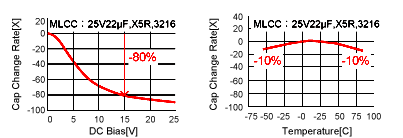
When a 15V DC voltage is applied, the capacitance of an MLCC can drop by up to 80%, with an additional 10% reduction under extreme temperatures. For instance, if a circuit requires 47µF at 15V DC, the actual usable capacitance is only about 20% of the nominal value.
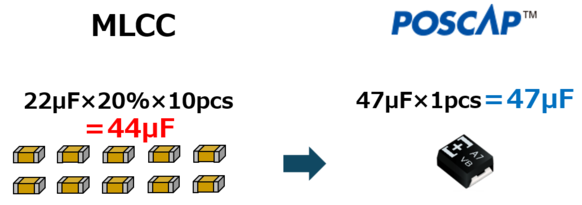
In this example, to secure the required capacitance of 47µF for the circuit, more than 220µF of nominal capacitance and over 10 units of 22µF MLCC are necessary. While it is possible to reduce the number of units by selecting MLCCs with larger capacitance, the typical approach is to use multiple low-cost small-capacity MLCCs, as larger-capacitance MLCCs are limited in availability.
Conversely, conductive polymer capacitors do not exhibit significant reductions in capacitance due to DC bias or temperature changes. Therefore, in this example, 10 units of 22µF MLCC can be replaced with a single 47µF conductive polymer capacitor, reducing the number of components and potentially decreasing total costs, including implementation costs, as well as reducing the implementation area.
Vibration Solutions for Robotic Arms
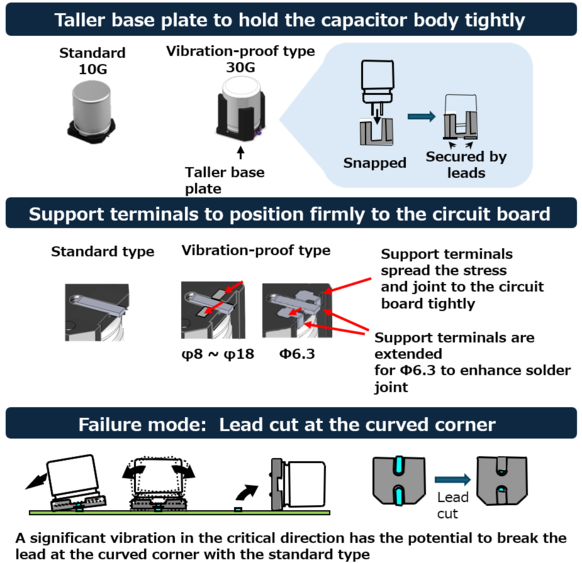
As robotic arms become smaller and lighter, the demand for compact components with high vibration resistance continues to grow. Panasonic’s conductive polymer hybrid aluminum electrolytic capacitors enable designs that support larger capacitance and higher current while reducing component count—saving valuable space.
For environments with intense vibration, Panasonic offers specialized vibration-resistant capacitors capable of withstanding acceleration up to 30G, in sizes ranging from 6.3mm to 10mm.
Traditionally, vibration reinforcement for standard components requires adhesives or bonding processes. By using Panasonic’s vibration-resistant products, these extra steps can be eliminated, simplifying assembly and improving efficiency for manufacturers.
Ensuring Reliable Performance in High-Temperature Environments
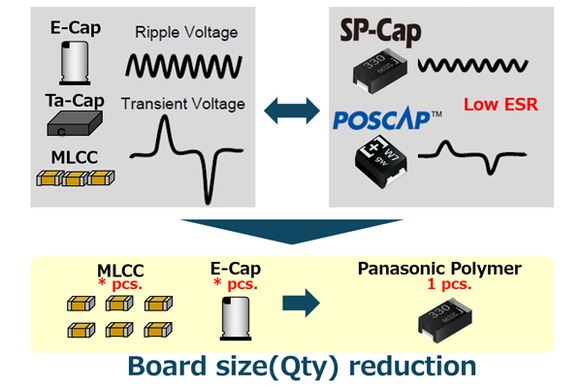
As industrial robots become more common, the need for components that can maintain stable operation under extreme heat is growing rapidly. Reliability is critical—any failure can directly impact productivity, making the choice of high-performance components essential.
Panasonic’s SP-Cap series is engineered for durability in harsh conditions, delivering an impressive lifespan of up to 5,500 hours at 135°C. This makes them ideal for robotic applications that operate under continuous high loads and elevated temperatures.
The POSCAP series offers robust performance in compact designs, with a guaranteed lifespan of 1,000 hours at 125°C. These capacitors are perfect for applications requiring high capacitance in small form factors and can safely replace traditional MnO₂ capacitors.
For exceptional longevity, Panasonic’s OS-CON capacitors stand out, offering up to 20,000 hours at 105°C. The SVT series, for example, boasts an expected lifespan of 12.8 years at 90°C, ensuring long-term reliability for robotic arms operating in high-temperature and demanding environments.
Additionally, Panasonic’s conductive polymer technology provides significantly lower ESR compared to conventional aluminum electrolytic and tantalum capacitors. This advantage reduces component count and saves space on circuit boards, supporting the miniaturization of robotic systems.
Inductors for High-Reliability Robotics
Inductors for High-Reliability Robotics
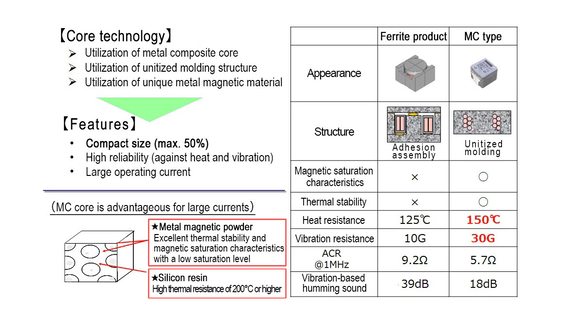
Panasonic’s Metal Composite (MC) Power Inductors are designed with a proprietary magnetic material core and an integrated molded structure. This advanced design delivers outstanding performance in a compact form factor, ensuring excellent resistance to heat and vibration—critical for reliable robotic applications.
Optimized for High-Temperature Environments
MC inductors provide superior magnetic saturation characteristics and thermal stability, enabling consistent operation even under extreme conditions.
Compared to traditional ferrite types,Power inductors offer clear advantages in:
-
Magnetic saturation performance
-
Thermal stability
-
Heat and vibration resistance
-
Lower AC resistance (ACR)
These features make Power Inductors an ideal choice for next-generation robotic systems that demand durability and efficiency.
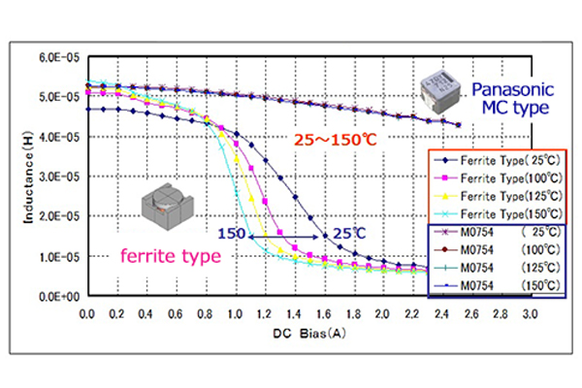
The graph illustrates data plotted under varying conditions (25°C, 100°C, 125°C, and 150°C) to compare the magnetic saturation characteristics—also known as DC superimposition characteristics—of MC-type and ferrite-type inductors. Magnetic saturation occurs when inductance drops sharply at a certain current level under DC bias, making it a critical performance factor.
Ferrite inductors typically exhibit pronounced saturation behavior, as shown in the graph: their inductance decreases significantly with higher DC bias and fluctuates with temperature. In contrast, Panasonic’s MC-type inductors maintain stable inductance without a steep decline, indicating minimal saturation, and show only slight temperature dependence. This stability is especially important for power inductors, which operate under conditions that generate heat.
Exhibiting durability in harsh environments with superior heat and vibration resistance
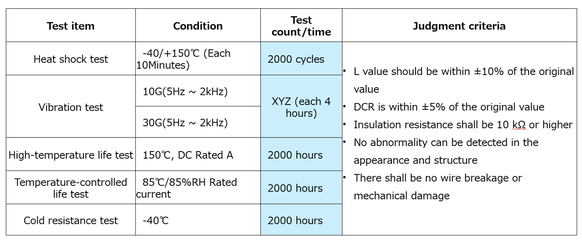
Panasonic’s MC-type inductors deliver exceptional reliability, making them ideal for automotive applications. Each inductor undergoes rigorous testing to ensure durability, including heat shock cycles from -40°C to 150°C for 2,000 cycles and heat resistance at 150°C for 2,000 hours.
See overview on standard automotive test items and conditions.
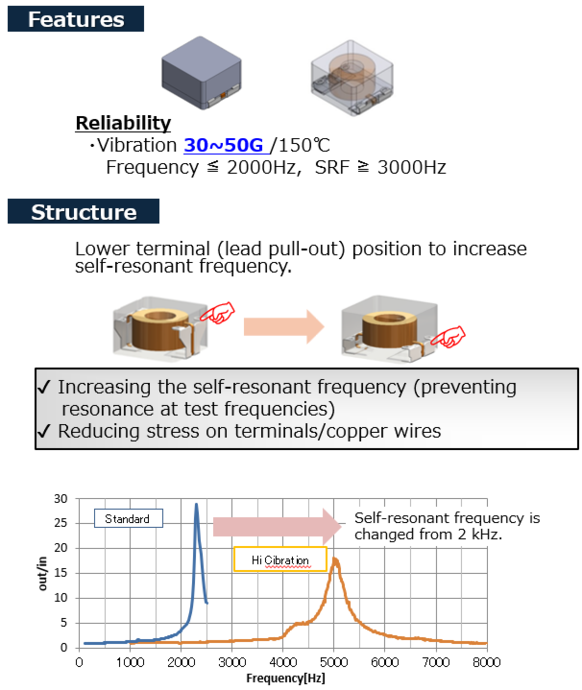
Contributing to higher energy efficiency with low AC resistance (ACR)
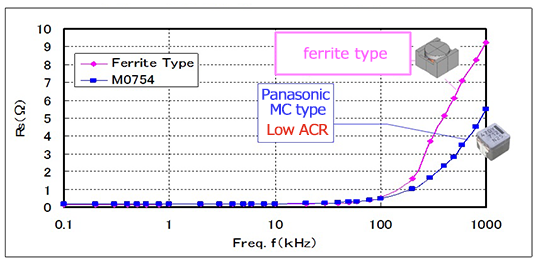
As frequency increases, current distribution within a conductor becomes uneven due to the skin effect and proximity effect. This causes the current to concentrate near the surface, while the center carries less current. As a result, the effective resistance rises at higher frequencies — a phenomenon known as AC resistance (ACR).
In inductors, increased ACR directly leads to higher AC losses and greater heat generation.
The graph below compares the ACR behavior of metal composite (MC) inductors and ferrite inductors. While ACR increases with frequency for both types, MC inductors show a significantly smaller rise.
This results in:
- Lower AC losses
- Reduced heat generation
- Improved efficiency at high frequencies
Overall, Panasonic inductors offer a clear advantage in applications where efficiency and thermal performance are critical.
Target circuit points and benefits of Panasonic Inductors
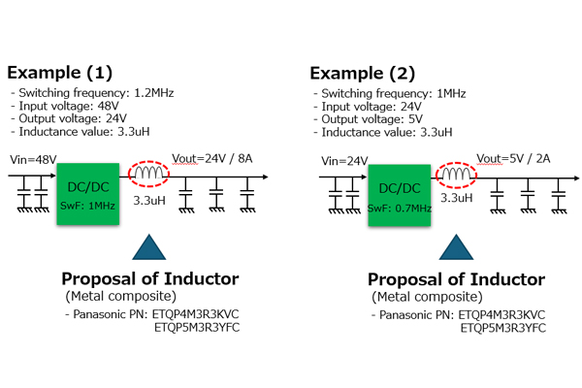
The following components are recommended for use in circuits.
Resistors
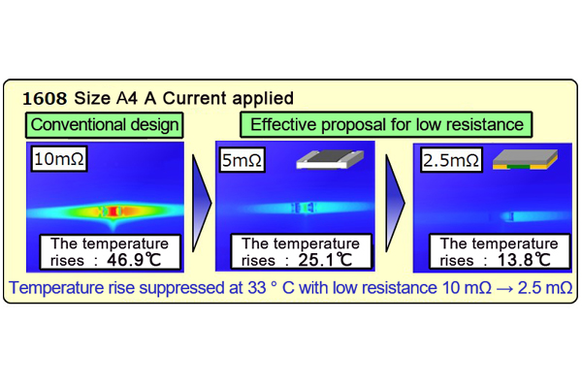
Enhancing energy efficiency with low-resistance current detection chip resistors
The figure below demonstrates how resistance value impacts heat generation when a current of 4A is applied. For instance, lowering the resistance from 10 mΩ to 2.5 mΩ can reduce heat generation by approximately 33 °C.
Panasonic introduces advanced current detection Chip Resistors with ultra-low resistance
Anti-sulfur resistors enhance reliability in environments with high sulfur content. Typical areas with elevated sulfur exposure include locations near volcanoes, hot springs, highways with high vehicle emissions, and industrial sites using cutting oils or rubber-based products. Even in general environments, sulfur can emanate from materials such as lubricants or greases used in cooling fan motors, rubber seals for packing or vibration isolation, and certain mold resins. Silicone-based coating materials can accelerate sulfur-induced corrosion (sulfuration). Thus, in such conditions, the use of chip resistors designed with sulfur resistance is essential.
Panasonic's anti-sulfur chip resistors achieve superior reliability by replacing traditional silver electrode materials with highly sulfur-resistant alternatives. Panasonic offers two resistor series tailored to specific requirements: one focused on absolute performance and another optimized for longevity, balancing performance and cost considerations.
- Gold-based electrode pursuing absolute performance
The ERJS series utilizes gold-based electrodes, recognized for their exceptional stability and superior sulfur resistance. - High palladium electrode enhancing longevity effects
The ERJU series employs a silver-palladium (AgPd) alloy electrode with high palladium content, significantly improving sulfur resistance by suppressing silver diffusion.
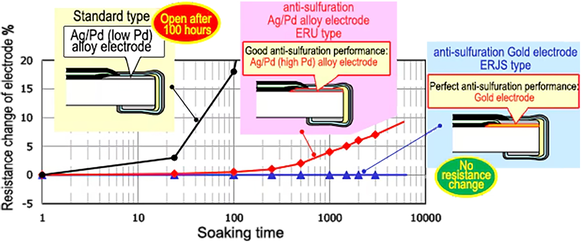
See the immersion test results comparing Panasonic’s anti-sulfur chip resistors against general-purpose resistor electrodes when immersed in sulfur-containing oil.
In typical resistor electrodes, the low palladium content commonly results in failures (disconnections) after approximately 100 hours of sulfur exposure. In contrast, Panasonic’s ERJU series resistors, featuring high-palladium silver electrodes, exhibit no disconnection even after 3,000 hours, substantially enhancing reliability. A direct correlation exists between palladium content and time-to-disconnection; thus, the ERJU series is designed to withstand exposure exceeding 12,000 hours without failure. The ERJS series, with gold-based electrodes, demonstrates even higher reliability, showing no measurable change in resistance values after 3,000 hours.
Superior Sulfur Resistance for Long-Term Reliability
.
Standard chip resistors reach their limits at 155°C and require early power derating due to inherent self-heating.
With the ERJH series, Panasonic overcomes these challenges. Thanks to its extended temperature capability of up to 175°C and delayed derating starting at 105°C, the series enables robust, high-power circuit design in high-temperature applications such as automotive and industrial systems.
Conclusion:
Passive components are essential for optimizing robotic performance. Selecting the right capacitors, inductors, and resistors is critical to addressing challenges such as durability in harsh environments and miniaturization.
Panasonic remains committed to advancing the robotics industry through innovative passive component solutions, while expanding customization options and technical support to meet evolving customer needs.
| Component | Product Feature | Recommend Series | High Voltage | Large Current | Low Loss | Small Size | High Resistance to heat | High Precision |
| Conductive Polymer Aluminum Electrolytic Capacitors (SP-Cap) |
|
JX, KX, TX, JZ, KZ, TZ series |  |
|
|
|||
| Conductive Polymer Tantalum Solid Capacitors (POSCAP) |
|
TDC, TQC series |
|
|
||||
| Conductive Polymer Aluminum Solid Capacitors (OS-CON) |
|
SVPT, SVT series |
|
|
|
|
||
|
Conductive Polymer Hybrid Aluminum Electrolytic Capacitors |
|
Anti-vibration type | |
|
|
|||
| Power Inductors for Automotive Applications |
|
LP, LE series |
|
|
|
|
|
|
| Chip resistor |
|
Anti-pulse: ERJP Thin film high precision: ERA*A/ERA*V Shunt: ERJ*W, ERJB/D Anti-sulfurated: ERJU/ ERJS |
|
|
|
|
Tool Introduction
Characteristic Viewer
The characteristic viewer is a tool that graphically displays various characteristics of selected components on frequency and temperature axes. It facilitates easy verification of component characteristics such as changes in characteristic values within the operating frequency range, serving as a useful tool for component selection.
Industrial/automotive LC filter simulator
Industrial & Automotive use LC filter simulator user registration - Panasonic
The industrial/automotive LC filter simulator is a content tool that simulates attenuation characteristics when filters are configured using our power inductors and aluminum electrolytic capacitors suitable for industrial and automotive applications. Please utilize it for component selection in industrial and automotive filters.
Features:
- Filter circuit simulation is possible in π, T, and L configurations.
- Simultaneous comparison of 5 circuits is possible.
- Supports parallel and series connection of components.
- Allows output of simulation results (attenuation characteristics) in graph and CSV formats.
Lifetime calculation for Hybrid/Aluminum Electrolytic capacitor
Hybrid/Aluminum Electrolytic capacitor Estimated Lifetime Calculation Tool
Lifetime calculations provide critical insights into how Panasonic hybrid and aluminum electrolytic capacitors will perform under specific conditions, helping to predict potential failures before they occur. By analyzing factors such as temperature, voltage, load conditions, and environmental influences, engineers can estimate the expected lifespan of these capacitors.