
Replacing Thermal Grease Issues with GraphiteTIM Solutions
Introduction
TIMs (thermal interface materials) are materials used to fill gaps between heat-generating components and heatsinks to reduce the contact thermal resistance in order to increase heat dissipation effects. Although thermal greases are the most commonly used TIMs, they have several issues.
This article will introduce a problem solving case example for power modules used in power conversion applications, such as inverters, by replacing the TIM from thermal grease to GraphiteTIM
Thermal Management Using Thermal Greases and Their Issues
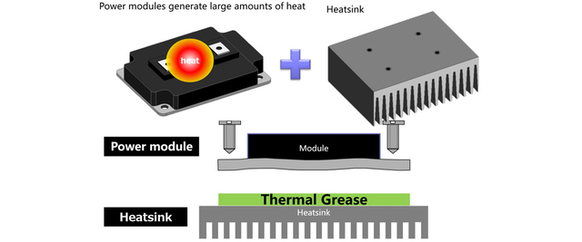
Power modules generate significant amounts of heat and are therefore typically mounted to heatsinks or similar cooling structures to dissipate that heat. When mounting a heatsink on a power module, joining them as they are will inevitably create gaps between the base plate and heatsink because the base plate is slightly distorted. As a result, the dissipation effects of the heatsink cannot be fully obtained due to the contact thermal resistance caused by inadequate adhesion.To address this issue, as shown in the image, thermal grease is applied between the base plate and the heatsink as a thermal interface material (TIM). The grease fills the interfacial gaps, reducing contact thermal resistance and thereby enhancing the overall heat dissipation performance.
HOWEVER, THE FOLLOWING ISSUES HAVE BEEN POINTED OUT WITH THERMAL GREASES
Thermal resistance variations due to voids
Gaps may not be completely filled because of the application amount and uniformity of thermal greases, and the resulting voids may cause the inadequate reduction in contact thermal resistance.
Increase in thermal resistance due to dryout phenomenon
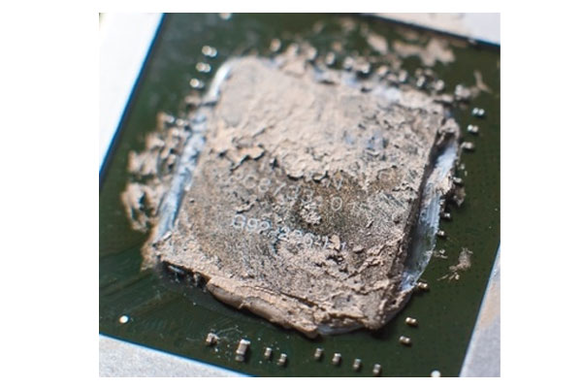
The dryout phenomenon refers to a condition whereby the components of thermal greases evaporate due to heat, separating oil and filler. When greases degrade due to dryout, they become hard and crack, increasing the contact thermal resistance.
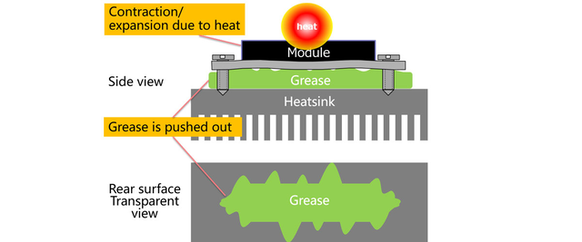
Increase in Thermal Resistance Caused by the Pump‑Out Phenomenon
During long‑term operation, repeated expansion and contraction of the base plate can induce a pump‑out phenomenon in which thermal grease is gradually forced out of the interface. As the grease layer thins, voids form between the mating surfaces, leading to increased contact thermal resistance.
Increase in total costs
It is also necessary to implement periodic maintenance (disassembly → cleaning → application → assembly) to address performance degradation due to dryout and pump-out phenomena.
Therefore, although thermal greases themselves are cheap, total costs are high.
Problem Solving Case Example by Using GraphiteTIM
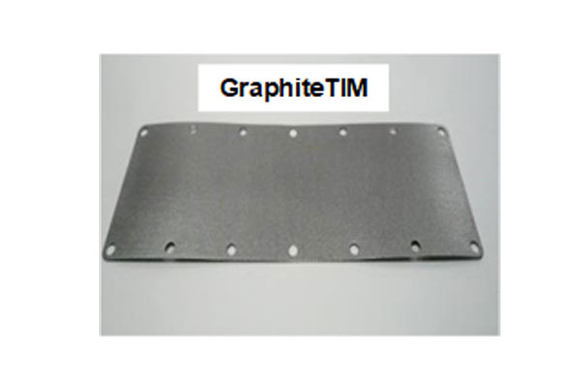
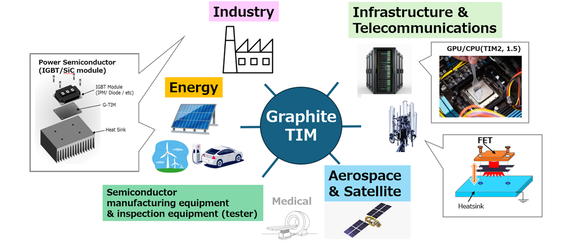
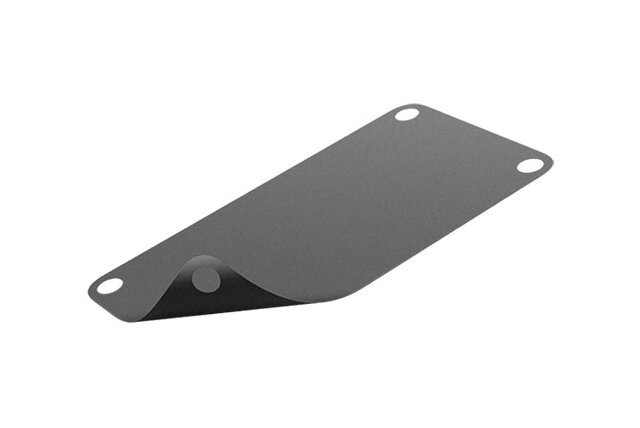
By using GraphiteTIM (graphite-based thermal conduction sheet) instead of a thermal grease, the thermal grease issues listed above can be resolved. GraphiteTIM, which is a sheet-like part material with excellent thermal conductivity, is a Panasonic TIM sandwiched between heating elements and heatsinks. Although a GraphiteTIM needs to be sandwiched with adequate pressure to obtain favorable thermal characteristics, it is very easy to install and handle and has excellent reliability. The table below summarizes the features of thermal greases and GraphiteTIM.
| Thermal grease issues | Thermal conduction sheet Graphite TIM |
| Thermal resistance variation due to voids | Absorbs differences in level through its high compressibility, achieving a stable thermal resistance equivalent to that of thermal greases |
| Increase in thermal resistance due to the dryout phenomenon | Heat-resistant to temperatures over 400ºC; no degradation due to heat |
| Increase in thermal resistance due to the pump-out phenomenon | Physical properties remain unchanged semi-permanently |
| Increase in total costs | Easy installation that only requires placement and simple maintenance ⇒ Low total costs |
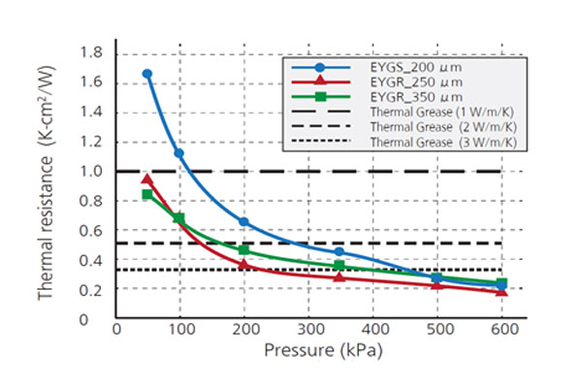
The graph on the right illustrates how the thermal resistance of GraphiteTIM changes as a function of applied pressure. As the pressure used to compress the GraphiteTIM increases, its thermal resistance decreases. Under high compression, the GraphiteTIM exhibits thermal resistance comparable to that of conventional thermal greases. This demonstrates that Graphite TIM can effectively serve as a direct replacement for thermal greases without performance concerns.
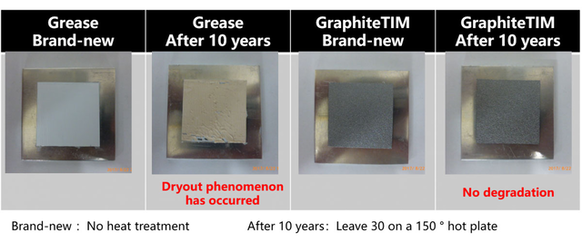
The results of a test that assumes dryout due to heat are also shown below. The photos show brand-new states and states after being left on a 150ºC hot plate for 30 minutes as an acceleration test to simulate a 10-year period. No degradation due to heat was observed with Graphite TIM, indicating that dryout issues can be resolved.
Summary
Thermal greases are TIMs with a long history and have been widely used in various areas. However, they have issues related to reliability and total costs. The thermal conduction sheet GraphiteTIM has excellent performance and high reliability as a substitute for thermal greases and can therefore resolve the issues with thermal greases.
GraphiteTIM applications