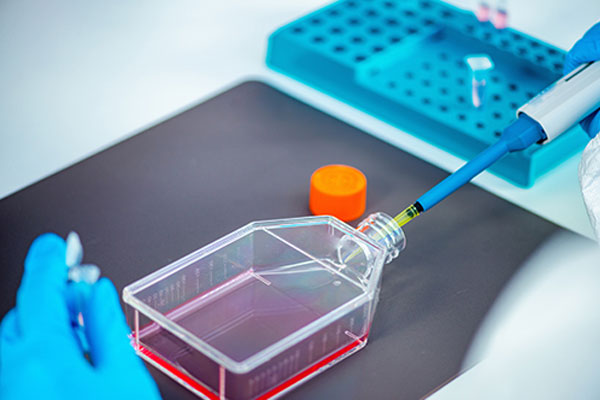

Smarter liquid monitoring for cell culture automation
Automated cell culture workflows live and die by reliable fluid delivery. Whether you are feeding media, dosing supplements, or running wash cycles, consistent liquid monitoring is essential to maintain process stability, reduce variability, and scale up throughput. The Panasonic FD‑BEF Fiber Series was developed specifically for cell culture equipment to make liquid monitoring and tubing handling simple, robust, and repeatable in real-world automation environments.
Why liquid monitoring is critical in automated cell culture
In a cell culture automation platform, the liquid path must remain predictable over long runtimes. A missing tube, an empty line, or inconsistent flow conditions can cause interruptions, wasted consumables, or inconsistent results. That’s why engineers increasingly look for sensing solutions that do more than just “detect liquid”, they also need to verify correct setup and support fast maintenance without adding complexity to the machine design. The FD‑BEF concept addresses these needs by combining liquid presence sensing with practical tubing handling features that suit lab automation constraints.
FD-BEF in a nutshell: built for cell culture apparatus
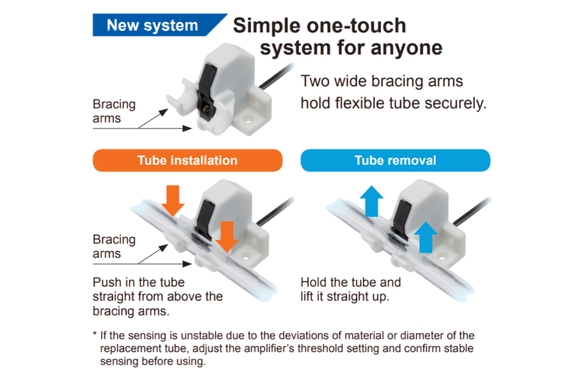
The FD‑BEF is a liquid detection fiber sensor designed for tubing used in cell culture equipment, with an emphasis on usability and serviceability. Panasonic highlights an “extremely easy” approach to tube handling, aimed at day-to-day lab realities such as frequent tube replacement, cleaning routines, and quick turnaround between runs.
One-touch tube installation. No ties, no tools
Traditional approaches often require cable ties, dedicated tools, and careful tightening to avoid tube deformation, followed by sensitivity readjustment after every change. FD‑BEF is designed to eliminate that headache with a one-touch system: operators can install or remove tubing quickly, without specialized training or tool kits.
A practical bonus for machine builders: the sensor design supports two mounting orientations, allowing you to choose upward or sideways tube removal depending on how your fluidic deck is laid out.
Tube compatibility that matches real bioprocess setups
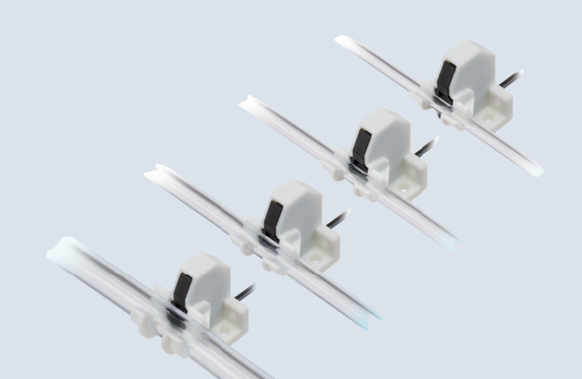
Cell culture systems typically standardize on silicone or PVC tubing for flexibility, sterility workflows, and compatibility with common media transfer modules. The FD‑BEF supports silicone and PVC tubes in multiple outer diameters; Ø4 mm, Ø5 mm, Ø6.4 mm (1/4 in), and Ø9.5 mm (3/8 in), making it suitable for a wide range of automated bioprocessing designs.
Multi-state monitoring: liquid presence and tube presence
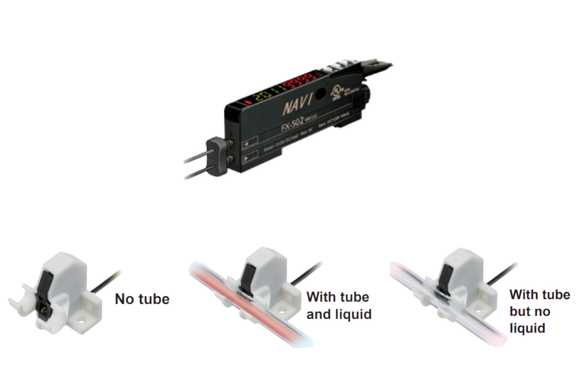
One of the most engineer-friendly advantages of FD‑BEF is that it can be used to monitor not only fluid, but also the presence of the tube itself, a key safeguard against setup errors and incomplete maintenance steps.
When FD‑BEF is paired with a 2-output fiber amplifier such as FX‑502 / FX‑502P, the system can indicate three distinct states:
- No tube
- Tube present + liquid present
- Tube present + no liquid
For lab automation engineers, this supports smarter interlocks and diagnostics. Instead of treating every issue as “no liquid,” you can differentiate between:
- a tubing installation issue (tube missing), and
- a process issue (tube installed but empty), and
- normal operation (tube installed with liquid).
That distinction helps reduce false runs, prevents avoidable air-in-line situations, and improves troubleshooting speed, especially when equipment is deployed across multiple sites with different operators.
Designed for compact machines: flexible routing with tight bend radius
Space is always tight in lab automation: pumps, valves, manifolds, and tubing runs are packed into compact decks. The FD‑BEF fiber core is designed to be flexible and robust, supporting a very small bending radius of 2 mm, which helps engineers route sensing lines through constrained geometries without compromising layout freedom.



Typical use cases in cell culture automation
FD‑BEF is especially useful wherever tube-based fluid transfer must be verified before (and during) operation, such as:
- Media feed lines to culture vessels
- Buffer/cleaning lines in automated wash cycles
- Supply lines where “tube not attached” must be detected early
- Multi-channel systems where fast tube changes are part of routine operation