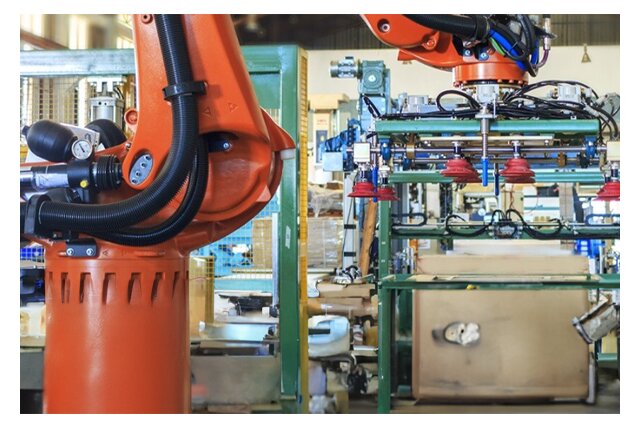

Our offering for humanoid robotics
What components does Panasonic Industry make for humanoid robots?
Panasonic Industry provides a wide portfolio of core components for humanoid robots across five solution areas: energy and power management, thermal management, signal and connectivity, sensing and interaction, and motion/actuation. The lineup is built on automotive-grade reliability, drawing on technology proven in in-vehicle power supplies, ADAS systems, and cooling modules.
The portfolio includes super capacitors, Active Optical Cables (AOC), board-to-wire and FPC connectors, Graphite thermal interface material (TIM), PhotoMOS® semiconductor relays, conductive polymer capacitors, tactile pressure sensors, and ultra-compact integrated motors.
Good to know
Panasonic Industry's humanoid robotics offering brings automotive-proven reliability to the emerging humanoid market — components validated in vehicles now solve robots' toughest problems in power efficiency, heat, noise, and signal integrity.
Which humanoid robot challenges do these solutions address?
Humanoid robots face four recurring engineering challenges, and Panasonic Industry maps a solution to each:
| Robot challenge | Panasonic solution | Core benefit |
|---|---|---|
|
Short operating time / high power draw |
Recovers regenerative energy, extends runtime, protects battery life |
|
|
Heat from SoC/GPU and motors |
Quiet, long-life cooling and low-resistance heat transfer |
|
|
Magnetic noise from multi-axis motors |
Noise-free, high-speed signal transmission for stable motion |
|
|
Device failure from vibration/shock & fault events |
Contact-wear-free switching and fast, safe shutdown |
The five solution areas at a glance
- Power & Energy — EDLC modules for regenerative energy recovery and peak-power assist.
- Thermal Management — Cooling fan motors and Graphite TIM for quiet, reliable heat control.
- Signal & Connectivity — Active Optical Cables and low-profile connectors for noise-free, space-saving wiring.
- Sensing & Interaction — Tactile pressure sensors for precise grasp and slip detection.
- Motion & Actuation — Ultra-small integrated motors and servo motors for stable motion and stronger lift.
Super Capacitors for Humanoid Robots | Regenerative Power & Assist
Panasonic super capacitors recover braking energy and deliver instant peak-power assist for humanoid robots — extending runtime, cutting heat, and protecting battery life.
How do super capacitors extend humanoid robot runtime?
Panasonic super capacitors store the regenerative energy a robot generates during deceleration and release it as force energy during acceleration. This recover-and-reuse cycle reduces overall power consumption, extends operating time, and suppresses peak current draw from the battery — which cuts heat and prolongs battery life.
Three value points define the solution:
- Lower power consumption — regenerative energy is recovered and reused rather than wasted.
- Heat countermeasures — the motor drive's regenerative resistor can be removed.
- Longer operation and life — peak current is suppressed, reducing battery charge/discharge stress.
Why are Panasonic super capacitors different?
Panasonic cells deliver both high power density and high energy density through proprietary material and electrode technology - a combination competing supercapacitors and lithium-ion batteries don't match in the same footprint.
Panasonic's SCL Gen1 super capacitor reaches 123 kW/L power density, with the SCE series at 49.5 kW/L — leading its class on power while retaining high energy density.
Next-generation SCE / SCL series specifications
|
Spec |
SCE Gen4 |
SCE Gen6 |
SCL Gen1 |
|
Capacitance |
110 F |
90 F |
200 F |
|
Rated voltage |
0–2.5 V |
0–3.0 V |
2.0–4.0 V |
|
DCR |
15 mΩ |
0.7 mΩ |
3.4 mΩ |
|
Operating temp. |
−40 to +70 °C |
−40 to +70 °C |
−40 to +85 °C |
|
Dimensions |
Φ18 × 70 mm |
Φ18 × 70 mm |
Φ18 × 70 mm |
|
Mass production |
Ready |
2027 |
2028 |
Reliability is inherited from Panasonic's in-vehicle backup power supplies — proven in demanding automotive conditions.
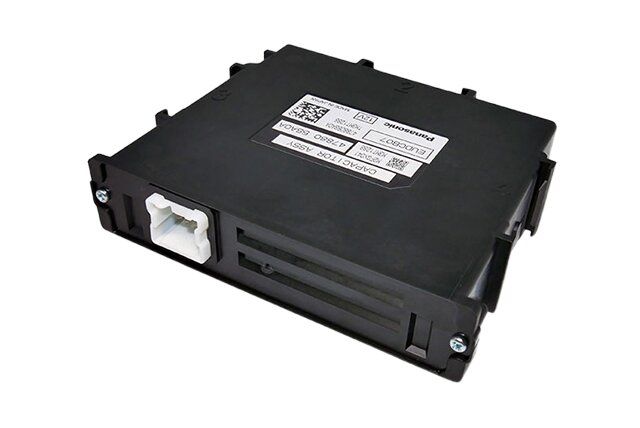
Active Optical Cable (AOC) for Robots | Noiseless High-Speed Data
Panasonic's Active Optical Cable transmits high-capacity data with zero noise superposition, enabling stable robot motion, electrical insulation, and lighter, more flexible wiring.
What is an Active Optical Cable and why do humanoid robots need one?
An Active Optical Cable (AOC) transmits data as light instead of electrical signals, so multi-axis motor magnetic noise cannot superimpose onto the signal. For humanoid robots — where multiplying motor axes create severe noise and cameras generate large data volumes — this enables stable control and high-quality imaging without the cost of added shielding.
Five benefits make AOC suited to robotics:
- No noise superposition — cable sealing is unnecessary, cutting development cost.
- High data capacity — up to 8 Gbps/channel, supporting high-quality, high-frame-rate imaging.
- Space-saving and light — enables more flexible motion than copper cables.
- Electrical insulation — protects machine and human (7 kV, CTI:600).
- Durability — lens-less, tough contact design withstands oil and harsh environments.
Active Optical Cable specifications
|
Parameter |
Specification |
|
Data rate |
20 Mbps–8 Gbps/ch (custom: up to 10 Gbps/ch) |
|
Interface |
Differential signal SLVS200 (LVDS), 8b10b coding, PHY phase only |
|
Channels |
Bi-directional 1ch / Uni-directional 2ch |
|
Power |
Typ. 90 mW/plug (max 115 mW) |
|
Cable length |
50/500/1000 mm (plug type); 1–10 m (optical cord) |
With commercially available optical cables, Panasonic's optical-terminal AOC can be extended up to 100 meters — far beyond copper's practical reach for high-speed robot data.
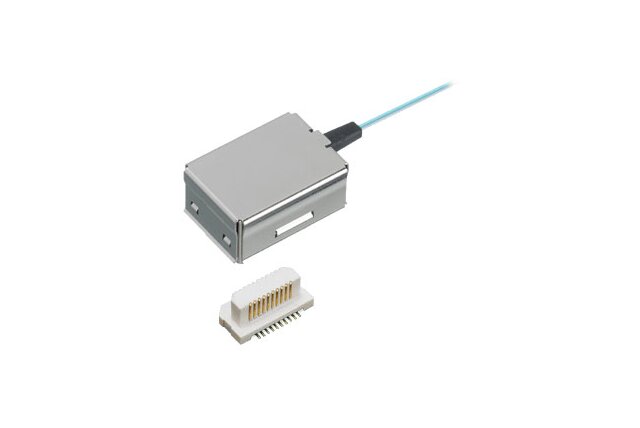
GraphiteTIM for Robots | Long-Life Thermal
Panasonic offers GraphiteTIM to keep humanoid robot SoCs, GPUs, and motors cool — quietly, reliably, and for 100,000+ hours.
What is GraphiteTIM and how does it improve robot thermal design?
GraphiteTIM (Thermal Interface Material) is a graphite-based heat-transfer material that offers low thermal resistance, high reliability, and easy installation — filling gaps between heat sources and heatsinks without the pump-out and degradation that plague thermal grease.
GraphiteTIM vs. grease:
|
Property |
Graphite TIM |
Grease |
|
Material stability |
Good |
Poor (unstable after cycling) |
|
Workability |
High |
Poor |
|
Pump-out / degradation |
None |
Yes |
|
Thermal resistance |
Good |
Good |
Specifications: thermal resistance as low as 0.4 K·cm²/W (250 µm), thickness options 200/250/350 µm, UL94 V-0 flame retardant, operating range −55 to +400 °C. Its high compressibility fills gaps with no pasting process required.
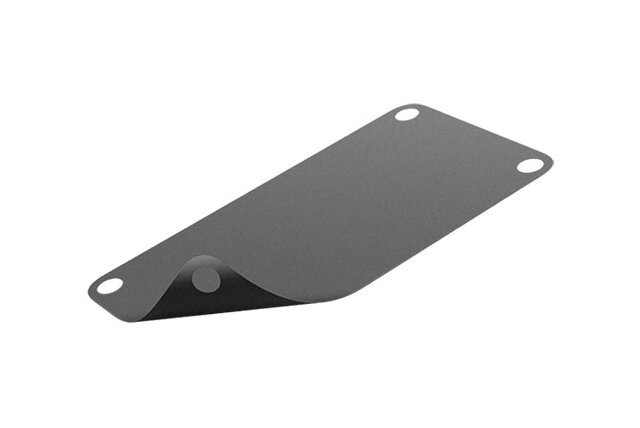
Board-to-Wire & FPC Connectors for Robots | Compact, Reliable
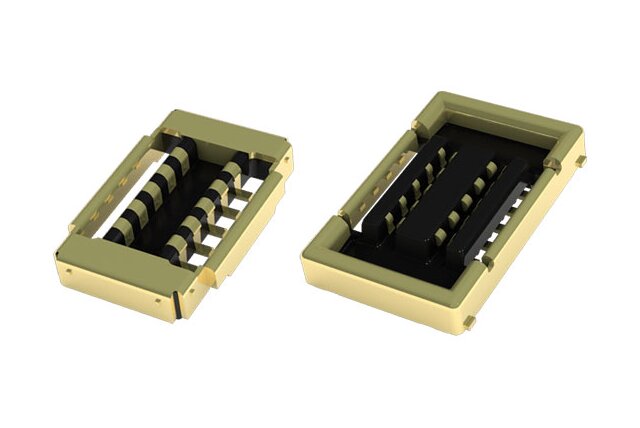
Panasonic's low-profile CW1 and CF1–CF3 connectors save space and weight in humanoid robots while delivering automotive-grade contact reliability.
Which connectors help reduce humanoid robot size and weight?
Panasonic's CW1 (board-to-wire) and CF1–CF3 (board-to-FPC) connectors are low-profile, space-saving designs that contribute directly to robot downsizing and weight reduction. They connect FPC directly to the board with high reliability using metal double-contact construction, cutting wiring bulk in compact robot joints and modules.
Connector lineup:
|
Model |
Type |
Pins |
Pitch |
Height |
Rated current |
|
CF1 |
Board-to-FPC, 1 row |
2–10 |
2.2 mm |
5.9 mm |
2.0 A/pin |
|
CF2 |
Board-to-FPC, 2 row |
16–40 |
1.0 mm |
11.8 mm |
1.0 A/pin |
|
CF3 |
Board-to-FPC, multi-direction |
— |
— |
8.9 mm |
— |
|
CW1 |
Board-to-wire |
2–8 |
2.5 mm |
3.4 mm |
3.0 A/pin |
All are rated for −40 to 125 °C operation with automotive specification, offering low-profile, simple-assembly, contact-reliable connections.
PhotoMOS® Semiconductor Relays for Robots | Safe, Fast Switching
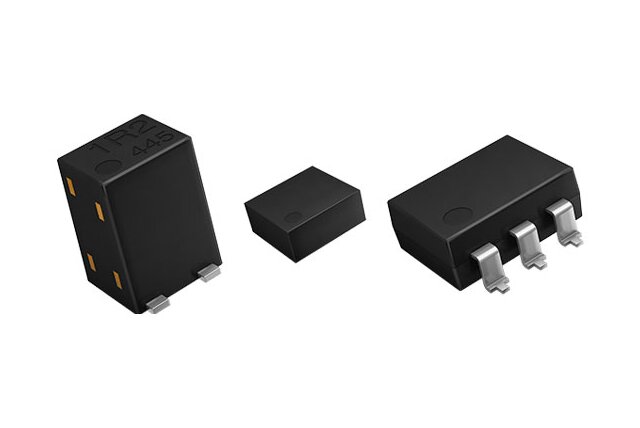
Panasonic PhotoMOS® relays give humanoid robots contact-wear-free, high-speed switching for safe motor shutdown and reliable multi-sensor signal routing.
Why use PhotoMOS® relays instead of mechanical relays in robots?
PhotoMOS® semiconductor relays switch using a MOSFET output rather than metal contacts, so there is no contact wear, faster switching, and fewer components than a mechanical relay. For humanoid robots subject to constant vibration and shock, this eliminates a common failure mode while enabling fast, safe fault response.
PhotoMOS® vs. mechanical relay:
|
Attribute |
Mechanical relay |
PhotoMOS® |
|
Output |
Metal contact |
MOSFET |
|
Contact wear |
Yes |
No |
|
Switching speed |
Slow |
Fast |
|
Component count |
Many (driving circuit) |
Few (1 package) |
Two robot applications:
- Safe shutdown — instantly cuts power if a motor runs out of control or a short-circuit occurs.
- Signal switching — routes signals from multiple sensors to the MCU.
Three benefits: high reliability (contact-wear-free, vibration-durable), prompt shutdown (high-speed relay), and small, light weight (minimal components). Lineups span from 60 V/0.4 A signal I/O to 600 V/10 A DC power switching.
Conductive Polymer Capacitors for Robotics | Stable, Compact
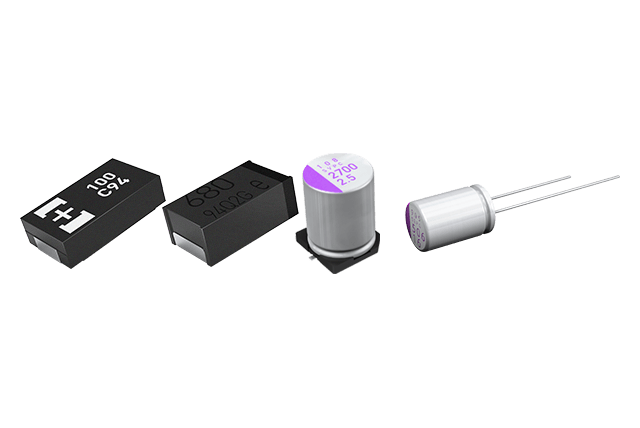
Panasonic's polymer capacitor lineup — SP-Cap, POSCAP, OS-CON, and more — delivers small size, stable capacitance, and long life across every power rail in a humanoid robot.
Where are polymer capacitors used in a humanoid robot?
Panasonic conductive polymer capacitors serve power rails throughout a humanoid robot — from the AC/DC front end and multi-phase DC/DC converters to SoC computing and high-power motor drives. Their stable, large capacitance is especially valuable at high-power motors, where MLCC capacitance drifts with voltage and temperature.
Three advantages over MLCC:
- Small and thin — SP-Cap and POSCAP fit tight robot spaces.
- Stable capacitance — unlike MLCC, capacitance holds steady across voltage and temperature.
- Long life and high temperature — high-reliability SP-Cap construction.
Lineup by voltage focus:
|
Product |
Voltage range |
|
SP-Cap |
2–6.3 V |
|
POSCAP |
2–63 V |
|
OS-CON |
6.3–100 V |
|
Hybrid Cap |
25–80 V |
|
E-cap |
25–100 V |
|
Film Cap |
275–1100 V |
MEGTRON Circuit Board Materials for Robots | High-Speed, Low-Loss PCB
Panasonic MEGTRON circuit board materials enable high-speed, low-loss signal transmission for compact humanoid robots — supporting reliable compute, sensor, and communication boards.
Why do humanoid robots need low-loss PCB materials?
Humanoid robots depend on high-speed computing, sensor fusion, camera data, and real-time communication between compact electronic modules. Panasonic MEGTRON circuit board materials support these demanding signal paths with low dielectric loss, high heat resistance, and reliable multilayer PCB performance — helping maintain signal integrity in dense robot control boards.
Three value points define the solution:
- Low transmission loss — supports high-frequency signal quality for advanced robot compute and communication boards.
- High heat resistance — contributes to reliability in densely packed electronics exposed to thermal stress.
- Multilayer PCB performance — enables compact, high-layer-count board designs for space-constrained robot modules.
How does MEGTRON support high-speed robot electronics?
The MEGTRON family is designed for large-capacity, high-speed transmission of high-frequency signals. For robotics, this makes it relevant wherever board-level signal integrity, thermal reliability, and compact multilayer construction are critical — from AI processor boards and sensor hubs to communication modules.
MEGTRON 8 improves transmission loss by about 30% versus MEGTRON 7 at 28 GHz, supporting next-generation high-speed communication performance.
MEGTRON lineup at a glance
|
Product family |
Performance focus |
Robot relevance |
|
MEGTRON 8 / 8S |
Ultra-low transmission loss, high heat resistance |
AI compute, high-speed networking, advanced sensor data paths |
|
MEGTRON 7 / 6 |
Ultra-low loss, proven high-speed multilayer PCB platform |
Reliable control boards, communication modules, high-density electronics |
|
MEGTRON 4 / M / 2 |
Low-loss and halogen-free options |
Cost-performance options for supporting boards and communication layers |

FAQ
- What does Panasonic Industry offer for humanoid robotics?
A component portfolio covering power and energy (super capacitors, EDLC modules), thermal management (cooling fans, Graphite TIM), connectivity (Active Optical Cables, connectors), sensing (tactile pressure sensors), and actuation (integrated and servo motors). - How do Panasonic super capacitors improve robot battery life?
They recover regenerative braking energy and supply instant peak-power assist, suppressing peak current from the battery — which reduces heat and extends battery life. - Why use optical cables instead of copper in a humanoid robot?
Optical cables (AOC) carry no electrical noise, so multi-axis motor magnetic interference can't corrupt the signal, enabling stable motion, up to 8 Gbps/channel data, electrical insulation, and lighter wiring. - How reliable are Panasonic's humanoid robotics components?
The portfolio is built on automotive-proven technology — for example, over 300 million cooling fan units shipped, and super capacitor reliability inherited from in-vehicle backup power supplies. - Are these components available now?
Availability varies by product. For example, SCE Gen4 super capacitors are production-ready, with SCE Gen6 targeted for 2027 and SCL Gen1 for 2028. Several items in the portfolio are in development.