
User story XtreeE
Transforming construction through digital manufacturing
The construction industry faces growing pressure to increase productivity, improve safety and reduce its environmental impact. Yet despite impressive advances in digital design and engineering software, many construction processes still rely heavily on manual labour, traditional formwork and decades-old production methods.
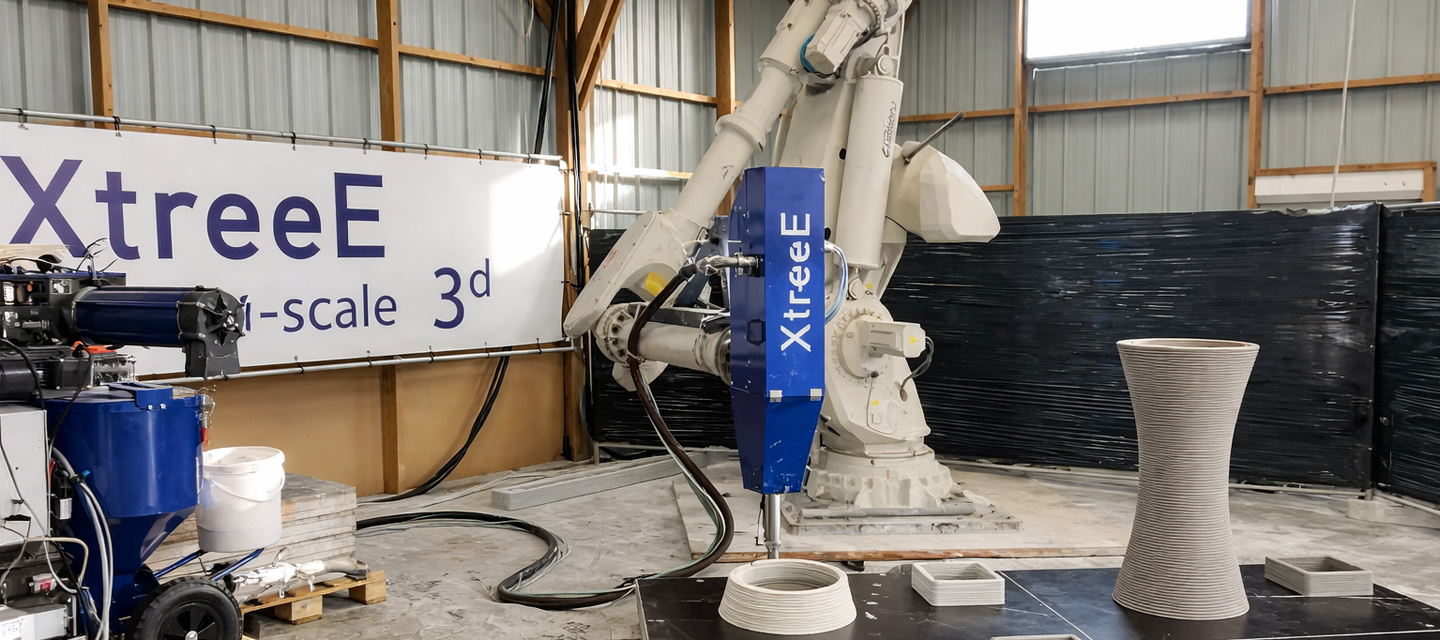
French technology company XtreeE was founded to help bridge that gap. The company develops large-format robotic concrete 3D printing systems that connect digital design directly to automated production. By combining robotics, software, materials science and process automation, XtreeE enables construction companies, precast manufacturers, universities and research centres to manufacture complex concrete structures efficiently and consistently.
XtreeE systems are material-agnostic by design. They print cementitious and ultra-high-performance concretes, low-carbon concretes and geopolymer binders, plaster, raw earth and recycled, waste-based materials, following the principle the company calls "the right material in the right place". For readability, this article refers throughout to concrete, which remains the most widely used material across XtreeE installations.

"Our mission is to give the construction industry a tool capable of producing complex, optimised shapes while increasing productivity and reducing both material consumption and carbon footprint," explains Alban Mallet, Co-founder, Managing Director and CTO of XtreeE. "The point is to make 3D concrete printing industrially viable, not just a demonstrator."
Ten years ago, most customers approached XtreeE to explore a promising new technology. Today, the market is increasingly shifting from experimentation towards industrialisation. Customers are no longer asking whether 3D concrete printing works. They are asking how it can be integrated into real production processes that deliver measurable business value.
From digital design to physical reality
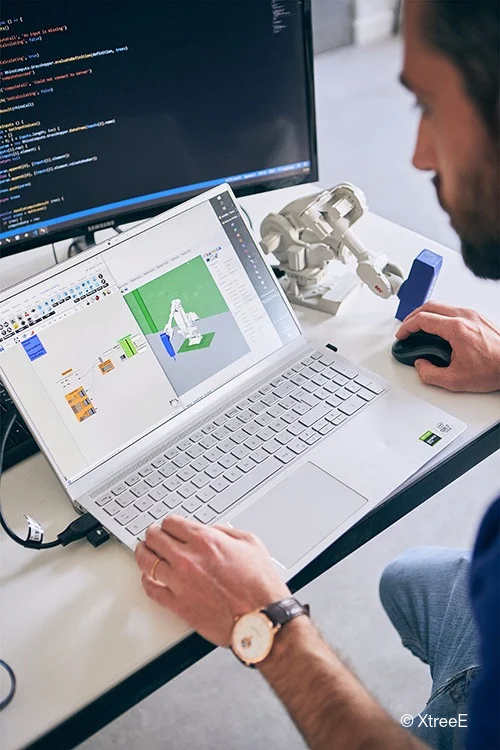
Unlike traditional construction methods, where workers build formwork manually based on paper drawings, XtreeE enables a direct digital workflow from design to production. A customer can create a digital model, optimise it through XtreeE Slice+, XtreeE's software suite for slicing, print simulation and path generation, and send it directly to the printing system for manufacturing.
This digital continuity unlocks entirely new design possibilities while eliminating many of the fixed costs associated with conventional manufacturing methods.
"With no mould, there is no fixed cost per geometry," says Mallet. "A one-off part costs the same as a repeated one."
The technology allows customers to create complex geometries, optimise material usage and introduce novel products that would be difficult or uneconomical to manufacture using traditional construction techniques. Applications range from architectural components and building elements to precast products and research projects. The majority are non-structural today, but a number of structural projects have already been delivered. Because the process places the right material exactly where it is needed, whether an element is structural or not becomes a design decision rather than a limit of the technology.
The Challenge: controlling a living material
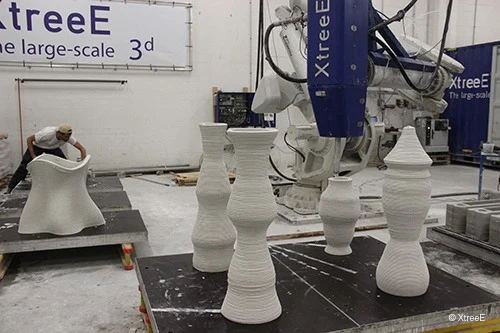
While robotic motion is a critical part of the process, the biggest engineering challenge lies elsewhere: the material itself.
Unlike many industrial automation applications, XtreeE is not simply controlling mechanical movement. It is controlling a living material whose properties continuously evolve throughout the production process. Factors such as temperature, humidity, material formulation and admixture composition all influence how the material behaves and when it begins to set.
"Concrete is a living material," says Mallet. "Our whole problem was to control its setting in real time, because with concrete there is no second chance. Without that control, there is no repeatability, and without repeatability there is no industrial product."
To achieve this level of control, XtreeE integrated pressure, temperature and torque sensors into its systems from the earliest design generations. These sensors continuously monitor the process and provide the information required to adjust material flow, dosing and machine behaviour in real time.
Those systems are in production today. EmPrinte by Spie batignolles operates two XtreeE machines and supplies precast elements to construction sites, meeting demand that conventional precasting could not address economically. In Perpignan, 3D Concrete uses the same technology for marine restoration, printing artificial reefs designed to help repopulate damaged seabeds.
The objectives were ambitious. The system needed to be robust enough for construction environments, simple enough for operators who are not robotics specialists, and economically viable for an industry where margins remain tight.
Automation as the conductor of the orchestra
At its core, the XtreeE solution consists of a robotic extrusion system. Material is first mixed into a homogeneous fluid paste before being pumped by xFEED, XtreeE's purpose-built pumping unit, towards xHEAD, the company's print head. At xHEAD, one or more admixtures can be injected immediately before deposition, allowing the material to begin setting at precisely the required moment.
Everything within the process is driven by controlled speed and flow parameters. Mixing speed, pump flow rate, robot travel speed and admixture dosing must all remain synchronised to ensure a consistent print result.
To give a sense of the operating envelope, the system delivers material at up to 10 litres per minute, the print head generally travels at 600 mm/s, and the process accepts aggregates of up to 10 mm. Around 50 process variables are captured every millisecond throughout the print.
"Automation is the conductor of the orchestra," explains Philippe Roux, Co-founder and Head of Software & Automation at XtreeE. "It collects the information from every sensor and gives the order to every motor, including the robot, so that the object is printed exactly as designed."
The operator remains in control through a simple interface, but the system itself continuously analyses process conditions and automatically adjusts parameters whenever required. This keeps operator training requirements low while ensuring reliable print quality.
Panasonic Industry: providing the control architecture
XtreeE and Panasonic Industry began working together in 2019. As XtreeE expanded its technology, automation became a strategic competency. The company wanted to bring automation expertise in-house and gain direct control over what it considers the core of its technology. After benchmarking several suppliers, Panasonic Industry emerged as the best fit for the company's combination of technical, commercial and operational requirements.
"We were not automation engineers, and the offers we had been getting combined expensive hardware with software that required real expertise," says Roux. "Panasonic gave us a motor range, free software and continuous support. That combination made our technology sellable."
FP0H PLC: The central brain of the system
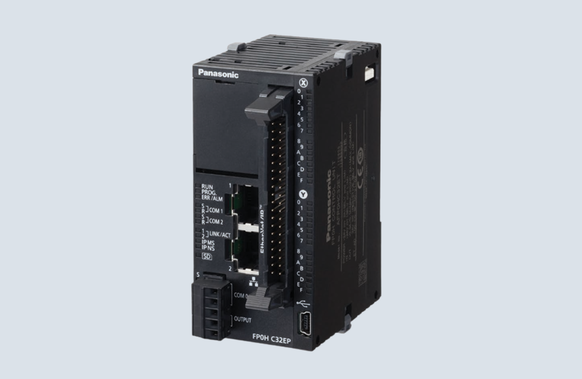
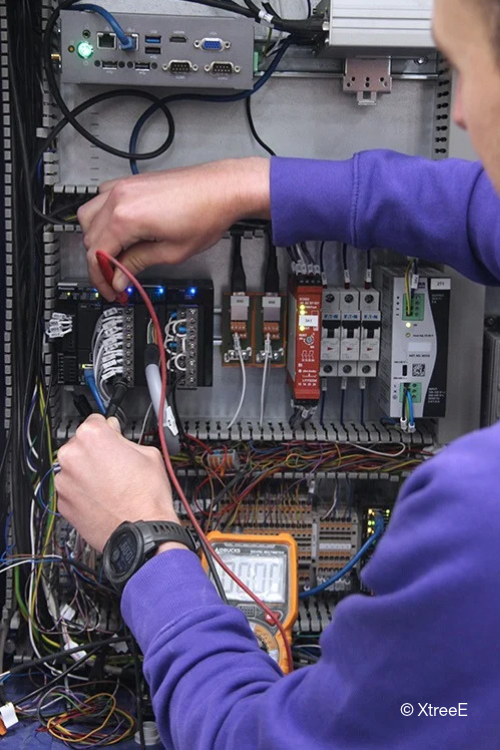
The Panasonic Industry FP0H PLC serves as the master controller of the XtreeE architecture. While industrial robots, primarily ABB systems, execute the physical trajectory, the FP0H sits above the robot and coordinates the entire printing process.
The PLC continuously receives robot position data, collects process information from temperature, pressure and torque sensors, processes operator commands and executes the control algorithms that keep the printing process stable.
Perhaps most importantly, the FP0H performs the closed-loop control functions that allow the system to automatically adapt to changing material conditions. Pump regulation, material flow optimisation and process synchronisation all depend on real-time calculations performed within the controller.
Because the PLC acts as a central control layer above the various subsystems, XtreeE can remain flexible and integrate third-party robots and pumps while maintaining consistent process behaviour.
MINAS servo technology controls the process
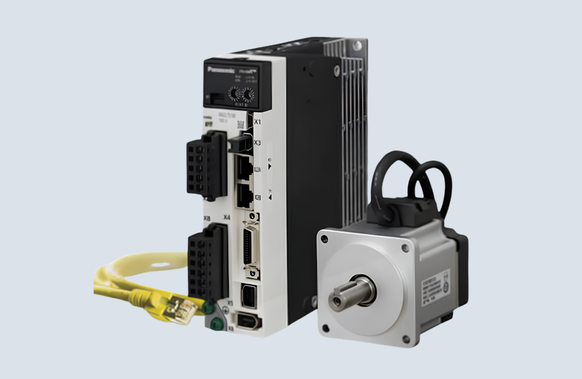
While the robot governs movement along the printing path, Panasonic Industry MINAS servo motors and drives control critical functions inside the print head itself. These functions include material handling, dosing and extrusion-related motion that directly influence print quality.
XtreeE initially adopted the MINAS BL platform and later migrated to MINAS A6 technology as the system evolved. Keeping PLC, drives and motion products within a common ecosystem simplified integration while maintaining the speed control accuracy and torque performance required by the application.
The application also presented unique engineering challenges. Large-scale robots required cable lengths of approximately 20 metres between control cabinets and motors mounted within the print head. Electromagnetic interference became a significant concern and required multiple iterations of cable design and shielding before a robust solution was achieved. Panasonic Industry specialists supported XtreeE throughout the process, helping resolve a challenge that was critical for reliable operation.
FP-I4C: From data acquisition to digital intelligence
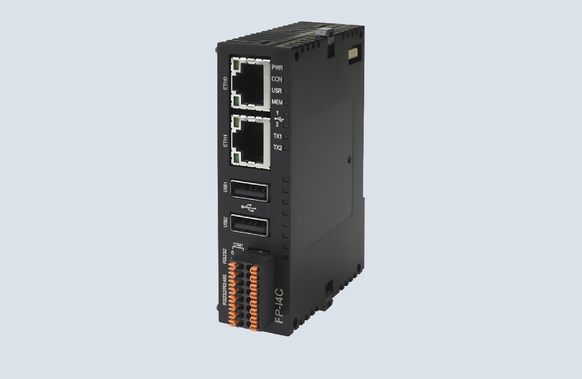
One Panasonic Industry component became even more important than originally expected: the FP-I4C IoT controller.
Originally introduced as a data collection platform, it quickly evolved into a central building block of the system architecture. Today, the FP-I4C hosts the operator supervision environment while simultaneously capturing high-frequency machine and process data throughout the printing cycle. The supervision and analysis layer XtreeE builds on top of it is the company's XtreeE Data Intelligence environment.
Sensor values, motor parameters, operator actions and robot position data are continuously logged and analysed. These datasets allow XtreeE to correlate process parameters with print quality, creating valuable insight into the behaviour of both materials and machines.
The collected information is what makes XtreeE's digital twin possible: a continuous digital thread running from the original design, through every process parameter mapped during printing, to the finished part. It serves as both quality control and a numerical production record, so that nothing is lost between what was designed and what was actually built. That same foundation supports predictive analysis, process optimisation and greater machine autonomy in future generations.
Building automation expertise together
For XtreeE, Panasonic Industry contributed more than hardware.
At the beginning of the project, automation was not a core competence within the company. Access to engineering software without licensing barriers, combined with local support and European automation experts, allowed XtreeE to build that competence in-house, progressively, and without buying it back project by project from external engineering firms.
"Support was not a comfort, it was what made the whole plan realistic," says Roux. "Without it, we would have stayed dependent on subcontractors instead of building the competence that now sits at the centre of our technology."
Today, XtreeE develops and controls its automation architecture internally, creating faster innovation cycles and greater independence.
Results: from demonstrator to industrial platform
The impact of the solution is evident in XtreeE's continued growth. Today, more than 25 XtreeE systems are installed worldwide across two generations of machines. According to the company, achieving this level of deployment would not have been possible with the original automation cost structures available on the market.
The integrated Panasonic Industry control architecture contributes directly to process stability through closed-loop pressure and torque control. Rather than allowing process variations to accumulate, the system continuously self-corrects during operation, improving repeatability and ensuring that parts can be consistently reproduced over time.
The benefits extend beyond print quality. High-frequency data collection enables remote diagnostics and performance analysis across the installed fleet, reducing maintenance costs and accelerating support activities.
At the same time, simplified interfaces and automation workflows have delivered practical operational benefits. Since the first generation of systems, XtreeE reports that commissioning and operator training times have been reduced by approximately 50%.
Looking ahead
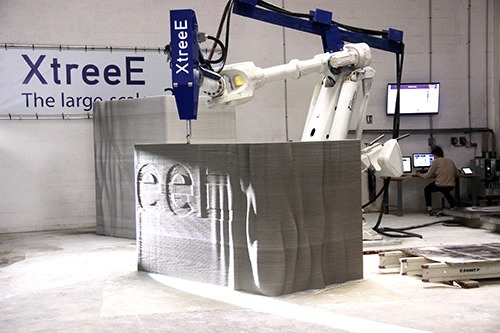
As the construction industry continues its transition towards digital and sustainable manufacturing, XtreeE sees enormous opportunities ahead for large-scale concrete 3D printing. The company's long-term ambition extends beyond architectural elements towards infrastructure, housing and civil engineering applications.
Achieving that vision requires more than robotics or new materials alone. It requires intelligent automation capable of connecting every process step, from mixing and pumping to extrusion and final deposition.
By combining XtreeE's expertise in digital construction with Panasonic Industry's control, motion and connectivity technologies, both companies are helping move large-format concrete printing from an emerging innovation towards a scalable industrial manufacturing process.