
Servo technology for CNC excellence
We know what truly matters. With over 100 years of experience in designing and manufacturing motors, including more than 30 years in the servo drive market, we have built unique expertise and solid technological foundations. We continuously listen to our partners and develop solutions that not only meet their real needs, but above all ensure the reliability of their machines.
Torsion Correction

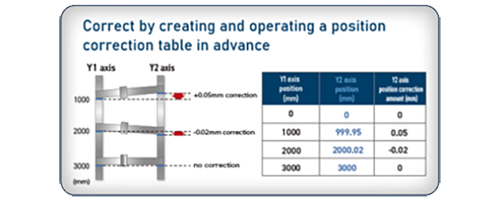
A squareness error occurs when the machine’s X and Y axes are not mutually aligned at an angle of 90°. It is most commonly associated with incorrect geometry of the machine’s guideway system. As a result, this error leads to geometric distortions and reduced accuracy of the machined parts.
Solution
The use of an internal correction table (Torsion Correction) enables compensation of linearity deviations. The table can be generated based on positions measured with a laser interferometer or by measuring torque values in coupled drives. This function increases positioning accuracy and enables effective compensation of squareness errors.
Mass ratio correction

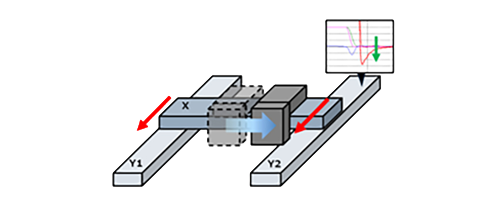
In the case of heavy cutting heads or gantry systems with a large span, the influence of the cutting head position on the operation of the servo drives positioning the gantry becomes clearly noticeable. Changes in the inertia ratio affect the effectiveness of compensation algorithms and, as a consequence, may lead to a deterioration in machining quality.
Solution
Dynamic inertia ratio correction enables continuous adjustment based on the current position of the cutting head, resulting in more stable axis operation and a noticeable improvement in machining quality.
Vibration

Vibrations in CNC machines are cyclic or irregular movements of machine components that occur during operation instead of smooth motion. They result from the inertia of mechanical systems and the limited stiffness of the machine structure. These vibrations reduce machine dynamics and lead to an increased position settling time.
Solution
The Damping Control function enables the reduction of residual vibrations with frequencies of up to approximately 100 Hz that occur during axis motion and stopping. Effective suppression of these vibrations significantly shortens the position settling time, resulting in higher process efficiency, improved motion repeatability, and enhanced machine performance.
Servo mismatch

Servo mismatch occurs when the dynamic responses of interpolated axes are not properly matched. In such a case, one axis leads the other during interpolated motion, resulting in distortion of the motion trajectory. As a consequence, the reproduction of the commanded path, particularly during circular interpolation, loses its geometric accuracy.
Solution
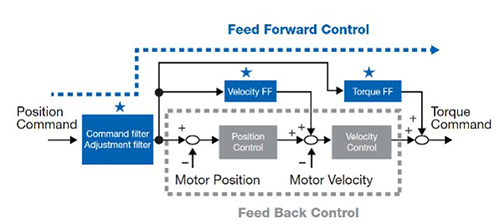
The Two-degree-of-freedom mode allows independent shaping of the drive response to the commanded trajectory and compensation of following errors. This makes it possible to decouple axis stiffness from the influence of dynamic disturbances that may occur during machining. As a result, the servo drive operates more stably, following errors are significantly reduced, and the quality of the machined part is markedly improved.
Reversal errors

Reversal errors (reversal spike / backlash) refer to a degradation of positioning accuracy at the moment an axis changes its direction of motion. This phenomenon manifests itself as characteristic marks or burrs on the machined surface.
Solution
Reversal spike compensation in servo drives (Quadrant Glitch Compensation) consists of temporarily increasing the drive torque during a change in the direction of motion. This eliminates transient torque deficiencies caused, among others, by friction nonlinearities and asymmetry in the servo drive response. Applying this function noticeably improves the surface quality of machined parts.
Stick–Slip

Errors resulting from stick–slip effect consist in the alternating stopping and sudden restarting of an axis during low‑speed motion. In practice, this phenomenon creates the impression of periodic “sticking” of the tool to the machined surface. The stick–slip effect is particularly visible on the workpiece surface, where it manifests itself as an uneven texture or characteristic machining marks.
Solution
Friction torque compensation is a servo drive function whose purpose is to reduce the influence of mechanical friction in the drive system. As a result, positioning accuracy, responsiveness, and motion stability are improved, especially at low speeds and during changes of direction.
Get in touch with a local expert

By combining Panasonic Industry’s global support network with local know‑how, we provide fast and competent support at every stage of project implementation.
Contact our expert Daniel Leszczewicz for your individual CNC question:
Phone +48-42-2309633